Weeds & Cultivation
Dealing with weeds will be a top priority when you take over your plot. You’ll have a mix of annual and perennial weeds to clear and there are different approaches to caring for your soil that can help!
-
Annual weeds
Annual weeds have shallow roots, so lightly forking over the ground loosens them and they can be composted. If you…
-
Perennial weeds
Perennial weeds include, in rough order of frequency: The worst offenders Couch grass and bindweed are the worst offenders —…
-
Cultivating your plot
There are three main ways to tackle persistent weeds and get the ground ready for sowing and planting — and…
Hatherop Road Allotments · Guide for new members
Weeds & cultivation
Dealing with weeds will be a top priority when you take over your plot. You’ll have a mix of annual and perennial weeds to clear.
Annual weeds
Annual weeds have shallow roots, so lightly forking over the ground loosens them and they can be composted. If you take over in summer there’s likely to be a lot to clear — cut off any obvious seed heads and bag them until you can dispose of them. Compost material is best in a bin, but can be piled up until you have one. If the ground is wet, soil clinging to the roots is valuable and should go in the compost too, ready to return to your plot.
Annual weeds are persistent: any seed shed into your soil over recent years will eventually germinate. Hoe or weed them out before they set more seed, and in a year or two you’ll have the problem under control by being persistent yourself.
Perennial weeds
Perennial weeds include, in rough order of frequency:
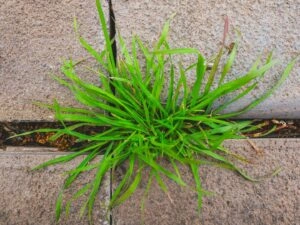
- Couch grass — tough, narrow cream roots running just under the surface before producing coarse grass clumps. Tops can be composted; roots rotted in water.
- Bindweed (columbine) — thick cream roots that break easily and regrow from a piece just an inch long.
- Dandelion — deep tap root that regrows if you only remove the top.
- Blackberry and raspberry — very invasive, deep roots that spread underground and pop up feet away. Good varieties can be saved and replanted to save money.
- Nettle — bright yellow roots that go deep; the composted tops make a good nitrogen feed.
- Thistle — deep-rooted with soft white tap roots.
- Mare’s tail — bright green spiky shoots like a miniature conifer, with deep travelling roots that are hard to spot. All parts should be removed from site.
Cultivating your plot
There are three main ways to tackle persistent weeds and get the ground ready for sowing and planting — and you can combine them. Each has its trade-offs. If you’re planning permanent raised beds and paths, you really do need to eradicate the pernicious weeds from the start, across the whole area.
Hand dig
The hard-work option. Done thoroughly you’ll remove about 95% of weed roots, leaving very little follow-up during the growing season. Dig with a fork so you don’t chop roots into fragments; remove annual weeds and soft top growth to the compost bin.
Start by loosening the surface and picking out shallow weed material. Then dig down a fork’s depth and turn over each clod, breaking it up and sifting through several times to pick out the roots. Work methodically so you don’t miss anywhere — the more care you take, the better the result. Large clods of weedy root can go in a separate pile; after a month or so the roots separate more easily from the soil, which returns to the plot clean.
Advantages
Can remove nearly all the weed, giving crops a great start
Ground gets dug over as you weed
Can sow or plant as soon as an area is ready
Good exercise — and it shows your commitment!
Disadvantages
Hard work
Disrupts the soil structure
You’re now ready to add compost or fertiliser and prepare a seedbed, plant potato or onion sets, or bed out young plants.
Rotavate
Apparently quick, but a rotavator can make the weed problem worse by chopping roots into hundreds of potential new plants — so you’ll probably still have to dig through and pick out the pieces. Repeated rotavating also tends to compact the soil and create a hard pan that prevents good drainage.
Advantages
Seems quick
Ground gets dug over, though not as well as hand digging
Disadvantages
You still have the hard work of finding all the weed roots
No dig
A method promoted by Charles Dowding (with many videos on YouTube), based on looking after the soil and denying weeds light so they weaken over time.
- Few weeds: a good mulch of compost 2–3″ (5–7 cm) in autumn, then tackle weeds before they take hold.
- Many weeds (mostly annuals): level the ground (slice off humps into the shallows), cover with cardboard leaving no gaps, then mulch with 4–6″ (10–15 cm) of compost.
- Brambles and woody growth: cut back with a spade below the surface before covering.
Weeds will try to push through — remove them as soon as you see them. Vigorous weeding in the first few years weakens the plants and means fewer issues later.
Advantages
Quick to get going
Can start planting straight away
Keeps soil structure intact
Disadvantages
Needs regular weeding as soon as weeds emerge
Cost of compost for a thick mulch